Tuesday, March 3, 2015

Slavery's Impact

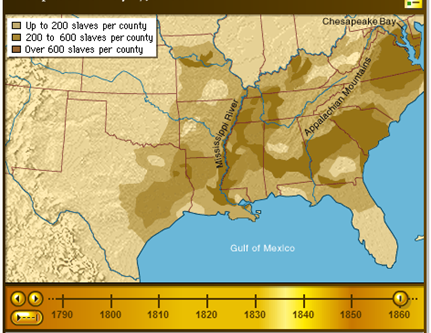
The essential questions for this lesson were How did slavery become both economically and politically entrenched in American society by the early 19th century, how does a system of slavery based on race affect human dignity, and what human characteristics does such a system tend to ignore. To start this lesson we read passages from Founders’ Constitution. One of the three sections that my group read and analyzed was Article 1, Section 9, Clause 1, “The Migration or Importation of such Persons as any of the States now existing shall think proper to admit, shall not be prohibited by the Congress prior to the Year one thousand eight hundred and eight, but a Tax or duty may be imposed on such Importation, not exceeding ten dollars for each Person.” After reading this we decided that it is saying, before 1808 the government was prohibited from imposing a tax on the importation of slaves but after 1808 the government could impose a tax on the importation of slaves. They could make you pay no more than $10 per slave. The second section my group analyzed and read was Article 4, Section 2, Clause 3, “No Person held to Service or Labour in one State, under the Laws thereof, escaping into another, shall, in Consequence of any Law or Regulation therein, be discharged from such Service or Labour, but shall be delivered up on Claim of the Party to whom such Service or Labour may be due.” This is saying that if any slave escapes into a different state, they will not be set free, but they would be returned to their owner. Overall this is saying that there is no way to escape once you become enslaved. We also read an article called Cotton is King: Slavery is Entrenched in American Society. This article talked about how people thought that slavery was declining and on the road to extinction. Then the cotton gin was created by Eli Whitney. The cotton gin would roll seeds out of the cotton so the cotton could be used to make cloth. This obviously helped the cotton production go faster so the need for more people to pick the cotton increased to keep up with the production. Between 1792, which was when Whitney invented the cotton gin, and 1794 the price of slaves doubled. Field hands who had brought $500 apiece in 1794 were worth $1500 by 1825. The number of slaves in the U.S. rose by 33% during the first decade of the nineteenth century. Along with these 2 articles we did an online activity called the Spread of Cotton & Slavery Activity. This talked about how cotton dominated the Southern and Northern States due to slavery and that even though the north did not have slaves they were still economically benefiting from the slave labor taking place. The pictures below are from this website.                                                                                  
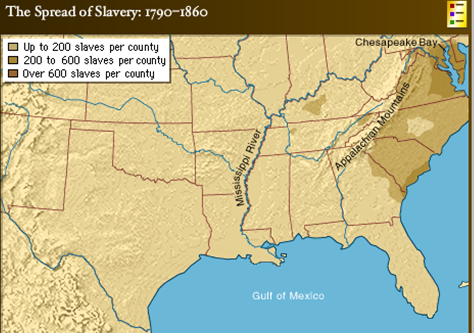
The one above shows the slave population in 1790 which was approximately 690,000. 
The picture below shows the slave population in 1860 which was approximately 3,954,000.                                                         
http://en.wikipedia.org/wiki/John_Brown_(abolitionist)
To start off the second part of the lesson, helping to answer the other 2 essential questions, we divided into groups and each group researched someone who was related to slavery prior to the Civil War. My group was assigned John Brown. John Brown was a radical abolitionist who had a lot of hatred for slavery and he believed in the violent overthrow of slavery. He was a conductor of the Underground Railroad and he established the League of Gileadites which was an organization established to help runaway slaves escape to Canada. He also freed many slaves and murdered slave owners. In 1859 at Harper's Ferry, him and his men raided the Federal Arsenal in hopes the slaves would become armed and join and start a rebellion. The rebellion was suppressed and he was captured. He was charged with Treason and then was hanged. Two of his sons were killed during the rebellion attempt. After exchanging notes with others in the class who researched the other two people, Fredrick Douglas and George Fitzhugh, we could move on. Next, we compared what slavery was like in Futa Jallon and what it was like Natchez. According to an article called ComparingSlavery, in Futa Jallon society was mainly divided by religion (Muslim or non- Muslim) and ethnicity had little relevance. While in the United States the slavery system was based on racial distinctions and permanent bondage. To wrap up this lesson, we watched a movie called Prince Among Slaves. This film was about the true story of Abdul Rahman, a Futa Jallon Prince, who was captured and brought to Natchez, Mississippi to then be sold to a white slave owner for a few guns, powder, and rum. He tried to tell Foster, his slave owner, that he was a prince and Foster gave him the name Prince. They cut off his hair and his hair was an important symbol of status. After escaping, he was on the run for weeks but he had nowhere to go and no food. He returned and was not punished. He got married to Isabella and had many children. Foster even gave him and his wife land to grow potatoes to sell for their own profit. Dr.Cox, someone Prince had helped back in Futa Jallon, tried to buy his freedom but died unsuccessful. Prince eventually got freed and had enough money to free his wife as well. Prince ended up dying in Liberia.  Every activity that we did during this lesson helped to answer the essential questions and to prove that race mattered and really demonstrated how horrible slavery was and how the slaves were treated.

Tuesday, February 10, 2015

Equality between Genders

During mid-19th century, women were not seen equal to men and were treated differently. To begin our Women’s Reform unit we analyzed a photo of a snapshot of a woman and her children in a typical day. A woman’s job during this time was to stay home and manage the house so it was a quiet environment, while their husbands were working. They were supposed to be in charge of the children’s education, the making the children’s clothing, keeping the children entertained, fixing broken things, cooking and cleaning, and they were supposed to do all of these things without any acknowledgement. Many of the tasks I mention are shown in this illustration, Sphere of Women.
Next, we read chapter 6: The Intimately Oppressed from HowardZinn’s “A People’s History of the United States”.  We read through it in groups and chose 5 excerpts we thought were intriguing. After, we did an activity called Laws and Practices. We read through The Rights of Women: Laws and Practice. We analyzed this and highlighted the legal limits women had and the limits people practiced but which were not part of the law. I really enjoyed reading this document because I find it interesting that many things that women did were not legal limits but were things that were just practiced. Additionally, we learned about the abolitionist movement. Then, we learned about the Declaration of Sentiments and Resolutions. It was modeled after the Declaration of Independence and it was written because women wanted the right to vote. The first half is the grievances and the second half covered the demands that they wanted. This lead to learning about the SenecaFalls Convention which was the first time the right for women to vote was publically demanded by a political group. Finally, we read one of the newspaper article reactions to the Seneca Falls Convention from the Library of Congress. My group read the Mechanics Advocate, Female Department. The very last activity we did was share what the reactions were from the articles each group read.

The essential questions for the Women’s Reform Movement was; How did mid-19th century American society react to women’s demands for equality and Does 21st century society still react differently to men and women? The reactions from the American Society depended. For example, from the article my group read, Mechanics AdvocateFemale Department, the reaction was that women should not fight for their rights. The article mentioned, “Every true-hearted female will instantly feel that it is unwomanly.” Another article that had a negative reaction was the OneidaWing. The article mentions, “If our ladies will insist on voting and legislating, where, gentlemen, will be our dinners and our elbows?” Although many reactions were negative, there was some positive reaction. For example, the NationalReformer had a positive reaction. The reaction from the society really depended on the situation. I think that the 21st century society still reacts differently to men and women. In class, we watched a Pantene Commercial that showed how men and women in the same position are given labels based on their gender. For example, a woman in high power could be seen as bossy, but a man in the same power would be seen as a boss. It is really surprising that women are still not fully treated equally to men. 

Tuesday, January 13, 2015

Dorothea Dix and the Prison Reform

Dorothea Dix had a huge impact on the Prison Reform in the 1840s. Dix went into prisons all over Massachusetts and recorded what she had observed from her visits. She witnessed the horrible conditions both prisoners and mentally ill people were kept in. Dix believed that the mentally ill and the criminals should be kept separate and the mentally ill should get the treatment they needed. The following is a section from Dorothea Dix, Memorial To The Legislature of Massachusetts (1843) :

"I come to present the strong claims of suffering humanity. I come to place before the Legislature of Massachusetts the condition of the miserable, the desolate, the outcast. I come as the advocate of helpless, forgotten, insane, and idiotic men and women; of beings sunk to a condition from which the most unconcerned would start with real horror; of beings wretched in our prisons, and more wretched in our almshouses. And I cannot suppose it needful to employ earnest persuasion, or stubborn argument, in order to arrest and fix attention upon a subject only the more strongly pressing in its claims because it is revolting and disgusting in its details.

I must confine myself to few examples, but am ready to furnish other and more complete details, if required. If my pictures are displeasing, coarse, and severe, my subjects, it must be recollected, offer no tranquil, refined, or composing features. The condition of human beings, reduced to the extremest states of degradation and misery, cannot be exhibited in softened language, or adorn a polished page.

I proceed, gentlemen, briefly to call your attention to the present state of insane persons confined within this Commonwealth, in cages, closets, cellars, stalls, pens! Chained, naked, beaten with rods, and lashed into obedience.

As I state cold, severe facts, I feel obliged to refer to persons, and definitely to indicate localities. But it is upon my subject, not upon localities or individuals, I desire to fix attention; and I would speak as kindly as possible of all wardens, keepers, and other responsible officers, believing that most of these have erred not through hardness of heart and wilful cruelty so much as want of skill and knowledge, and want of consideration. Familiarity with suffering, it is said, blunts the sensibilities, and where neglect once finds a footing other injuries are multiplied. This is not all, for it may justly and strongly be added that, from the deficiency of adequate means to meet the wants of these cases, it has been an absolute impossibility to do justice in this matter. Prisons are not constructed in view of being converted into county hospitals, and almshouses are not founded as receptacles for the insane. And yet, in the face of justice and common sense, wardens are by law compelled to receive, and the masters of almshouses not to refuse, insane and idiotic subjects in all stages of mental disease and privation. "

Source:
Dix, Dorothea. Dorothea Dix, Memorial To The Legislature of Massachusetts.  January, 1843. Teach Us History. http://www.teachushistory.org/second-great-awakening-age-reform/resources/memorial-legislature-massachusetts. Accessed on January 13th, 2015.

Annotation:

Dorothea Dix was writing to the Legislature of Massachusetts to convince them that the mentally ill should be kept and cared for separate from the criminals because they needed treatment. At the time, prisons consisted of both criminals and the mentally ill. Both were kept in horrifying conditions. Many were kept chained up with no heat, little to no clothing, and little to no food. In a lot of the prisons, violence and beatings were used to control the “creatures”. Dix referred to them as creatures because that was exactly how they were being treated. Dix was writing to the Legislature to let them know that the mentally ill were human beings and should be treated like them rather then treated like animals. Within the rest of the letter she mentions different cases that she witnessed at the prisons that she visited. This excerpt definitely gives me a good picture of this event. They way she goes into details and describes the conditions of the jails made it easy for me to picture it. Dix was trying to convince the Legislature to build separate asylums for the mentally ill so they can receive the medicine they need to get better.

Monday, January 12, 2015

Does Skin Color Still Matter?

This is the social pyramid we looked at. 

The essential question for the Latin American lesson was, “Why is it essential to acknowledge human value regardless of race? How are the events in the Latin American revolutions evidence of this social imperative?” In class, we studied the impact of race on Latin American revolutions for independence. First, we looked a pie chart of the race percent of the population in Latin America and we looked at a social pyramid. According to the pie chart, the Indian’s made up 50% percent of the population. The Creoles made up 23% of the population. They were the people who were born in the new world but whose parents were either Spanish or Portugal descent. The African Slaves made up 11% of the population. Both the Mullattoes & the Free Blacks made up 8% of the population. The Mullattoes were people with at least one parent with African descent.  The Mestizos made up 7% of the population and they were the people descended from a white parent and a parent with Indian heritage. The Peninsulares made up 1% of the population and they were the people born in Spain or Portugal who migrated over to the new world.  In terms of the social pyramid, it was the Peninsulares on top then it went the Creoles, the Mestizos, the Mullattoes, the Indians, and on the bottom the African slaves. After looking over both the chart and the pyramid, we then analyzed Casta Art. The painting showed the different types of names for different relations between people. This just proves the importance of racial distinction in Latin American colonies because there was a different word for everyone.

This is the Casta Art we analyzed. 
The next thing we did in class was an activity called 3 Routes to Independence. The first step was to create a timeline. The class divided into smaller groups and each group did one of the three topics: Mexico, Gran Colombia, or Brazil. Since there was more groups then topics multiple groups did each topic. My group did Gran Colombia and we then had to read through a summary of the Gran Colombia revolution and create a timeline with key events including important people.
Here is my group’s timeline: 

  • April 19, 1810- a junta expels the Spanish governor of the province of Venezula and takes controls
  • July 1811- a National Assembly in Caracas formally declares Venezulas independence 
  • July 1812- the Spanish recover a military initiative and regain control of the entire province 
  • 1813- Simón Bolívar returns to Venezula and wins six successive engagements against Spanish forces 
  • August 6, 1813- he enters Caracas and takes political control with doctoral power
  • July 1814- Bolívar has once more lost Caracas; he goes to Bogotá and he succeeds in recapturing from the Spanish  
  • End of 1817- he is back in Venezula and building up a new army in an inaccessible region on the Orinoco River
  • 1819- Bolívar's small force of only 2500 men, uses cowhide boats to cross a succession of flooded tributaries of the Orinoco and a mounting crossing 
  • August 7, 1819- the Spanish Army surrenders 
  • August 10, 1819- Bolívar enters Bogotá
  • December 17- the Republican de Colombia is proclaimed (covers modern day Colombia, Ecuador, and Venezula
  • Venezuela; June 24, 1821- Bolívar wins a battle at Carabobo which brings him once again Caracas 
  • Ecuador;May 24 1822- Antonio José Sucre wins a victory at Pichincha and brings the patriots into Quito
  • Bolívar remains ruler until 1830, he resigns and wanted to retire in Europe but dies of tuberculosis 
  • September- Ecuador and Venezuela formally form Gran Colombia

After creating our timeline and having it approved by our teacher we did a jigsaw activity. My group which did Gran Colombia had to get together with two other groups. One group had to have Mexico and the other group had to have Brazil, so that we could exchange timelines. Within our jigsaw groups, we had to come up with 2 similarities among all 3 revolutions and come up with 2 differences between all the 3 revolutions. For the two similarities, my group came up with that all of the revolutions had the same time period of events and that 1822 was the year all the countries gained their independence. For the first difference, my group came up with Brazil was a peaceful revolution and Gran Colombia and Mexico were both violent revolutions. The second difference my group came up with was that the three revolutions were in different places, there were different leaders, and they were fighting against different things. In the Brazil Revolution, at first Jose was killed because he did not have an elite status and then Pedro tried to make Portuguese people the only people with power. In the Mexico Revolution, Miguel called for the end of 300 years of racial equality. In the Gran Colombia Revolution, Bolivar’s main goal was to liberate New Granada from Spanish control. Even though the revolutions had three different routes to independence, race was an issue in all three.

Judgments are still being made based on race in today’s society and that is just wrong. One big example which brought up a big up rise was the Michael Brown shooting in Ferguson, Missouri. An 18 year old black man was shot by a white Ferguson police officer on August 9, 2014. The officer that shot Brown was found not guilty. When Brown was shot he was unarmed and many believe that he was surrendering while the police officer shot him. This incident led to numerous amounts of protests and continued on for a while. Because of Brown’s skin color many believed that was why he was shot. This could be true or false, but either way race should not be something people should still base judgments, decisions, or anything else off of. Race is still an issue in our world today and it should not be.

Tuesday, December 9, 2014

Was Andrew Jackson's Reputation Deserved?

The Essential Question of the Andrew Jackson lesson is, "Is Andrew Jackson's long-standing reputation as "the people's president" deserved? Why? Why not?" For this lesson, the class divided into 6 groups and 2 groups research one of the three topics. The topics were the Bank War, Indian Removal, and Spoils System. Four out of the six groups said that Jackson does not deserve the reputation as "the people's president". The other 2 groups said he did deserve it. During the Bank war, Jackson thought that the Bank of United States had too much power and could potentially control the whole economy. Jackson wanted to break the banks into smaller banks, so that the rich would not have all of the power. Jackson wanted to veto the charter, but the people were petrified that it would led to the economy to collapse. In this situation, he deserved the reputation as "the people's president". One of the situations where he does not deserve it is with the spoils system. The spoil system was when a political party gives government jobs to voters/supporters after an election victory. People were being given jobs based on their loyalty rather then their skill. He does not deserve the reputation in the case because he was a selfish man who only cared for the people who supported him and not the rest of the people. 
My group researched the Indian Removal. Here is our presentation:  

Wednesday, December 3, 2014

Rise of Democracy

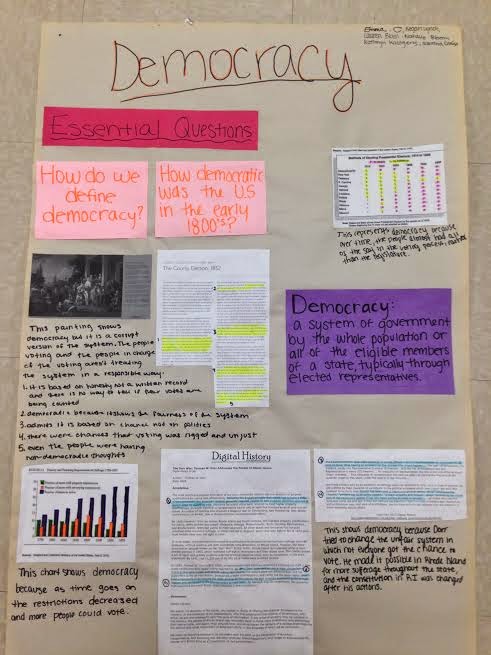
The essential questions for the Rise of Democracy lesson is “How should we define democracy? How democratic was the United States in the early 1800s?” For this lesson, we stayed within the groups we were already sitting in and analyzed the documents together. We examined a painting, an article explaining the painting, voting charts 1 and 2, primary source quotes, and another primary source about the Dorr War. Finally, to show what we learned we created a poster. Here is our poster:                                 

Tuesday, November 25, 2014

How Should We Remember Toussaint Louverture?

A good leader possesses many important qualities and is a person whom others look up to and rely on. Toussaint Louverture was a good leader and he was someone whom the slaves looked up to and relied on. Louverture spent a large part of his life dedicated to helping the slaves gain their freedom. The French took control of the western half of the large Caribbean island of Hispaniola in 1697 and named it Saint Domingue. In 1804, Saint Domingue was renamed Haiti and is still called that today. Saint Domingue was producing more than half of the world’s coffee and 40 percent of the world’s sugar by the 1780’s. Saint Domingue had 8,000 plantations producing these products and the work was done by 500,000 slaves owned by several thousand rich white planters. Sometime in the 1740’s, Toussaint Louverture was born into slavery. Louverture served as a slave in a couple of different positions. He was eventually granted freedom by his owner and went on to gain a small coffee plantation and attained a dozen slaves of his own. Louverture first emerged as a leader after the whites refused to end slavery. Thousands of plantations were burned and hundreds of white and mixed-raced people were killed as a response. Louverture encouraged slaves to fight for their freedom behind the scenes. Louverture commanded a rebel army against the French forces on the island in 1793, which lead to the abolishment of slavery in the French colonies in 1794. Louverture became the most powerful person on the island after he pledged loyalty to France and became commander-in-chief of the army in Saint Domingue. Napoleon, unexpectedly, had gained power in France and was planning to reinstate slavery. In 1802, Napoleon sent an invasion of 21,000 French troops and successfully captured Louverture. He was taken back to France and Napoleon then pulled out his troops giving up the fight. Louverture was put in a French jail and while he was dying from pneumonia Saint Domingue was celebrating victory because on January 1, 1804 Haiti became an independent nation. As a leader, Louverture had many great qualities and he should be remembered. Toussaint Louverture should be remembered for being a liberator of slaves, military commander, and ruler of Saint Domingue. His role as a liberator of slaves was the most important because everything he did was to fight for the freedom of slaves.
First off, Louverture should be most remembered as a liberator of slaves. Every decision he made was to benefit the slaves and help them gain their freedom. The start of the French Revolution in 1789 triggered the slave revolution of Saint Domingue. In 1791, the slave revolt began and Louverture served as a doctor to the troops and also commanded a small detachment of slave soldiers (Document A). He gained a reputation as a military commander for running a well-ordered camp and for training his men well. When the revolutionary government in France abolished slavery in 1794, Louverture and his troops stopped the revolt. Once slavery was abolished he pulled out his troops and ended the revolt. This shows how Louverture did whatever to benefit the slaves and changed sides based on who was trying to abolish slavery. Toussaint Louverture wrote a letter to the French Directory to discourage them from reinstating slavery. He was letting them know that if they tried to reinstate slavery the slaves would fight back. Louverture claimed in the letter that since the slaves knew what it was like to be free that they were willing to fight to the death. He said in the letter, “We have known how to confront danger to our liberty, and we will know how to confront death to preserve it” (Document B). This is him saying that they are threatening to fight back and not stop till death. Louverture was willing to work hard to help the slaves maintain their freedom. Additionally, Louverture lead the commission that created Saint Domingue’s Constitution of 1801. Article 3 promised all inhabitants of Saint Domingue that slavery be forever abolished and all men were born free, lived free, and died free (Document C). Also, Article 28 stated The Constitution nominate citizen Toussaint-Louverture, Chief General of the army of Saint Domingue (Document C). As long as Louverture is Governor he would never reinstate slavery. These are some of the many reasons why Toussaint Louverture should be remembered as a liberator of slaves.
Second, Toussaint Louverture should be remembered as a military commander. The Saint Domingue’s constitution of 1801 included that everyone must work on the plantation, but got to earn money. Basically, he was having the slaves do the same labor and work as before except this time they were to be paid and treated like “family”. Former slaves objected to this because they were being forced to work with poor conditions just like when they were enslaved. “The more [Toussaint’s] military had to [force] the former plantations slaves to do plantation labor, the more unpopular the army became,” (Document E). Louverture’s army was forcing the slaves to do the work they had been doing as slaves and they were not happy about that. Toussaint Louverture made his nephew, Hyacinthe Moyse, commander of all the Northern Department. Moyse preferred small holdings rather than large plantations. He would let the plantation workers be their own boss on a small piece of land. Moyse and the former slaves began to distrust Toussaint. They thought he was getting too close to the whites and it wasn’t fair to them to be forced into working again. A revolt broke out on October 29, 1801 and Louverture did not respond well to this. He stepped in and ordered many rebels to step out of line and kill themselves. During the revolt rebels cried, “General Moyse is with us-death to all the whites,” (Document E). Louverture then ordered Moyse to be arrested and executed. Louverture’s decision to arrest and execute his nephew was a decision made to maintain order. He was a military commander and he had to make pretty tough decisions. Between December 1801 and February of 1802 several ships left France and with help 31,131 troops landed on Saint Domingue. Toussaint had gained his soldiers respect with three important characteristics. He possessed humanity, generosity, and courage. A lot of what he did astonished people. The ships were going to the port city of Samana and according to Louverture it was to reinstate slavery. Toussaint Louverture ordered his generals to burn down the port city as the French were arriving. He did this so that when the French arrived they would be at a disadvantage because they were arriving to nothing. There were no resources for them to use as an advantage. When the French arrived, Louverture had his men retreat to the mountains. Within the mountains they could use guerrilla warfare. Louverture was a great military commander because he was both inspirational and did everything very strategically. Before fleeing to the mountains, Louverture gave a pep talk to his soldiers. In the speech he said, “That soul, when once the soul of a man, and no longer that of a slave, can overthrow the pyramids and the Alps themselves, sooner than again be crushed down into slavery,” (Document F).  He was preparing his men for war and letting them know that they should fight to death because they knew what it was like to be a free man. Toussaint Louverture should be remembered as a military commander.
Lastly, Toussaint Louverture should be remembered as a ruler of Saint Domingue. As Ruler of Saint Domingue, Toussaint Louverture created a Proclamation. The proclamation established more laws with regards to who is supposed to work and where they were to work. Also, it was to try and control the population that was refusing to work. He stated within this proclamation the consequences for the people who broke the rules he made. Since slavery had been abolished none of the former slaves wanted to go back and work just like when they were slaves. So, Louverture had to put in rules. The proclamation stated, “Vagabond cultivators arrested...shall be taken to the commander of the quarter, who will have them sent to the gendarmerie [local police] on their plantation,” (Document D). The people who did not want to work had to be arrested by the plantation police and forced to work again. The former slaves felt a lot like slavery was back even though that was not Louverture’s intention. He was putting in rules about agriculture because it was the island's main source of income and everyone depended on it. Louverture was a good ruler of Saint Domingue and should be remembered for it.

Toussaint should be remembered for being a liberator of slaves, a military leader, and a ruler of Saint Domingue. But, he should be most remembered for being a liberator of slaves. He did everything to help the slaves gain freedom and keep it. He would switch sides depending on who was fighting to abolish slavery. Louverture did a number of memorable things in his life and he should be remembered for all of them.